

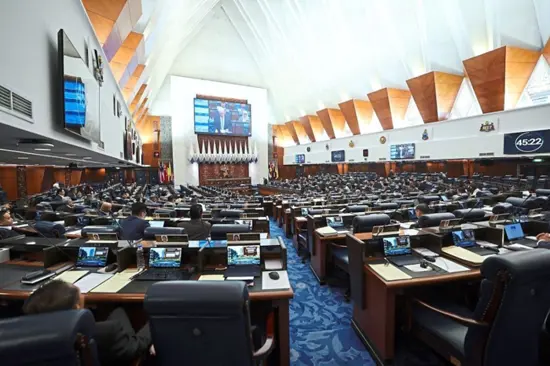
Dewan Rakyat passes Cross-Border Insolvency Bill 2025
KUALA LUMPUR: The Dewan Rakyat has passed the Cross-Border Insolvency Bill 2025, enabling local creditors to recover debts from insolvent companies within the Asean region.
The Bill was passed by a voice vote after being debated by 11 MPs from both the Government and Opposition blocs.
Minister in the Prime Minister’s Department (Law and Institutional Reform) Datuk Seri Azalina Othman Said, when concluding the debate, stated that the bill aims to boost investor confidence in Malaysia’s insolvency proceedings.
“This Bill will lay out a clear, modern, and effective legal framework for cross-border insolvency proceedings in Malaysia, in line with international best practices,” said Azalina in Parliament on Tuesday (July 29).
According to Azalina, her ministry has taken several steps to facilitate the enforcement of the Bill, which include a planned amendment to the Rules of Court 2012 and organising training sessions for stakeholders.
Azalina said the Legal Affairs Division (BHEUU), the Prime Minister’s Department, in collaboration with the Malaysian Judicial Academy, would conduct special training for High Court judges handling civil and trade cases.
Azalina said the training would be on understanding the United Nations Commission on International Trade Law (UNCITRAL) Model Law and how to handle cross-border proceedings.
At the same time, Azalina said that structured and phased training would be provided to all stakeholders, including lawyers, licensed liquidators, company directors, supervising agencies, and related professional bodies.
“The Malaysian Insolvency Department, as an administrative authority for insolvency, would focus on the formation of a special unit to handle cross-border cases and to train officers so they can be prepared in terms of technicalities and practices,” she said.
Azalina also said a special SOP would be developed for liquidators, lawyers, and company administrators to facilitate the enforcement of the bill.
“This reflects the government’s commitment to strengthen our judicial and legal institutions in facing a more complex global economic challenge,” she added.
Earlier, during debates, William Leong (PH-Selayang) said that while the adoption of the model law on cross-border insolvency could enhance investor confidence, key issues must be addressed to ensure its effectiveness.
“This law gives creditors greater assurance that their rights will be recognised and protected in cases of corporate failure. But several concerns remain,” he said.
Leong questioned how Malaysia would encourage major economies like China and Hong Kong, which have yet to adopt the model, to do so, to build a more universal legal framework.
He highlighted that the model law focuses on single entities, whereas many modern businesses operate within complex corporate groups that span borders, often channelling profits offshore.
“We must look into adopting laws that address group insolvency to enable restructuring of entire corporate groups,” he said.
He added that harmonisation of insolvency laws must include complementary frameworks to ensure creditors, workers, and stakeholders—especially locals—are not left vulnerable when assets are transferred abroad.
Khoo Poay Tiong (PH-Kota Melaka) said its implementation requires an in-depth study alongside the standardisation of guidelines across various institutions.
“Local laws should also be reviewed to ensure there are no contradictions,” Khoo said during debates.
Khoo also asked about the status of those declared bankrupt by courts abroad.
“Which of the Insolvency Department’s branches will manage the assets for the involved entity?” he asked.
Jimmy Puah (PH-Tebrau) also questioned the need to have a cross-border insolvency law, as only three countries within Asean have this law.
“Only three countries in Asean enacted this law. The rights of Malaysians, especially our local creditors, must be protected,” added Puah.
Responding to concerns raised by MPs, Azalina stated that the bill was introduced to establish an effective mechanism for handling cross-border insolvency cases.
“This can help investors to know what to expect when facing any financial risks, and this will also increase the confidence of foreign investors to invest and expand their businesses in Malaysia,” she added.
Azalina also said that local creditors are protected under this bill, as the existing ranking of claims, including priority debts, as provided for under Section 527 of the Companies Act 2016, will not be affected.
“The ranking of foreign creditors’ claims cannot exceed that of local general unsecured creditors.
“This ensures that the rights and priorities of local creditors continue to be protected in cross-border proceedings,” added Azalina.
To address concerns on national interests, Azalina said sub-clause 5(2) of the Bill allows the High Courts of Malaysia to reject any application for recognition or relief from foreign insolvency proceedings if it affects public interest, economic stability, capital markets, national security, or consumer confidence.
“The Court has full discretion to reject any form of recognition of foreign proceedings or judicial assistance, based on the principle of public policy as specifically enshrined in the Bill.
“This ensures that GLS remains subject to the principles of fair and responsible governance, while safeguarding the national priorities from any risks of external interference that may affect national interests,” she added.
According to the Bill, companies with debts to be paid would not only have their local entity be liable, but their foreign branches too. The law would also apply to foreign companies with overseas debt but having branches in Malaysia.
Currently, companies can claim they are unable to pay their debts, despite having assets and cash in other countries.
The Bill, however, excludes individual bankruptcies, limited liability partnerships, non-commercial government-related entities, and specific financial sector entities already governed by specialised regulations.











Leave a Reply