

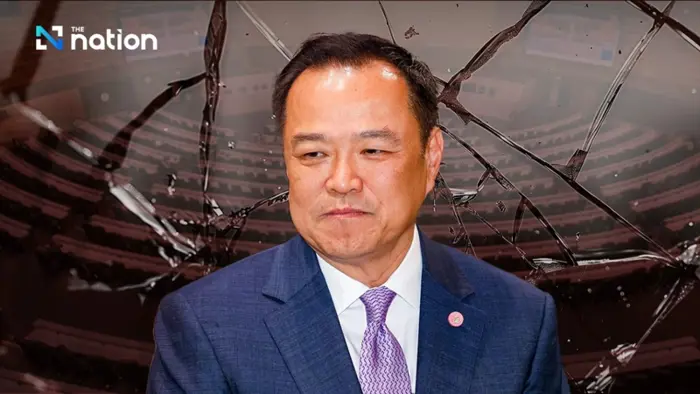
Four political signals hint Thai PM Anutin may dissolve House of Representatives
BANGKOK: “I must tell you when I’ll dissolve the House? It’s my prerogative. If I want to run, I will. If I want to quit, I’ll quit. I know when my last day will be. If I feel I can’t go on, I still have the authority of the prime minister,” declared Prime Minister and Interior Minister Anutin Charnvirakul (pic), when asked about rumours of a possible House dissolution by the end of this year.
According to Krungthep Turakij, four clear signals now point to an early dissolution of House of Representatives.
1. Populist policies flooding the field
The first sign is the wave of populist handouts — the “reduce, exchange, give away, and add-on” schemes. The latest, the “Let’s Go Halves Plus” (Khon La Khrueng Plus) campaign, opened for registration on Dec 20, prompting speculation that it was a sweetener for voters ahead of the polls.
The Senate’s approval on Oct 21 of the Joint Ticket Management Bill — seen as a move to expand the “buffet ticket” scheme from the 20-baht flat fare policy — has been widely viewed as an effort by the Bhumjaithai-led government to strengthen its public appeal.
The timing and design of these initiatives recall the late stages of the Prayut Chan-o-cha administration, which rolled out “Khon La Khrueng Phase 5” in July 2022, just months before the House was dissolved in early 2023. Anutin’s government has now rebranded the scheme as “Khon La Khrueng Plus,” alongside other welfare top-ups, signalling similar election-driven populism.
2. Rising nationalist tones amid border tensions
The second sign is the surge in nationalist sentiment. Anutin has taken a firm stance on the Thai–Cambodian border dispute, vowing not to sign any peace agreement unless Cambodia meets four Thai conditions — the withdrawal of heavy weapons, demining operations, suppression of transnational crime, and joint border management.
His strong rhetoric has also extended to the campaign against online scam networks, which Thailand has successfully elevated to a global agenda at the Inter-Parliamentary Union Assembly in Geneva, Switzerland.
Politically, the tough posturing plays well in Bhumjaithai’s strongholds — Surin, Buri Ram, Si Sa Ket, and Ubon Ratchathani — all key provinces along the Thai–Cambodian frontier.
3. Laying the groundwork for an election
The third signal lies in the strategic reshuffles and appointments. The Senate’s Oct 20 session approved Anan Suwannarat and Narong Rakroi as new members of the Election Commission, despite objections from some senators who alleged both had political ties to the “blue network.”
Narong’s past roles as governor of Uthai Thani and later Samut Sakhon — both provinces associated with Bhumjaithai’s political base — further fuelled speculation.
Meanwhile, the Interior Ministry’s major civil service reshuffle on Oct 14 was seen as placing loyalists across the provinces, laying a strong organisational foundation for an early election campaign. – The Nation/ANN







Leave a Reply