

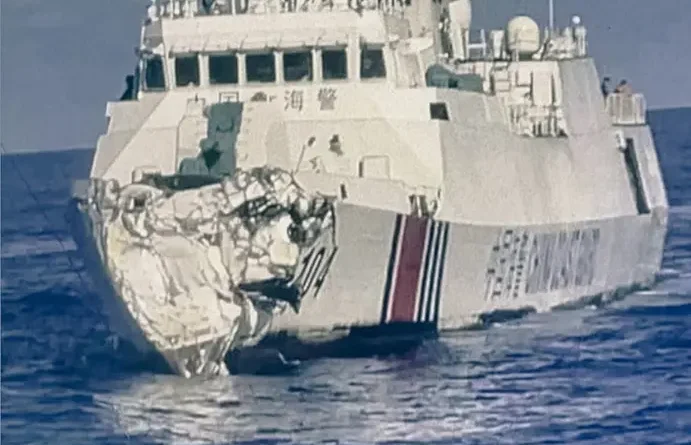
Collision between Chinese ships expected to escalate tension in South China Sea
More tension is expected in the South China Sea following a collision between two Chinese vessels, with analysts predicting the incident was likely to prompt Beijing to further increase its presence in the contested waterway.
Experts also warned that the incident could push China to enhance coordination between its navy and coastguard to prevent similar accidents in future.
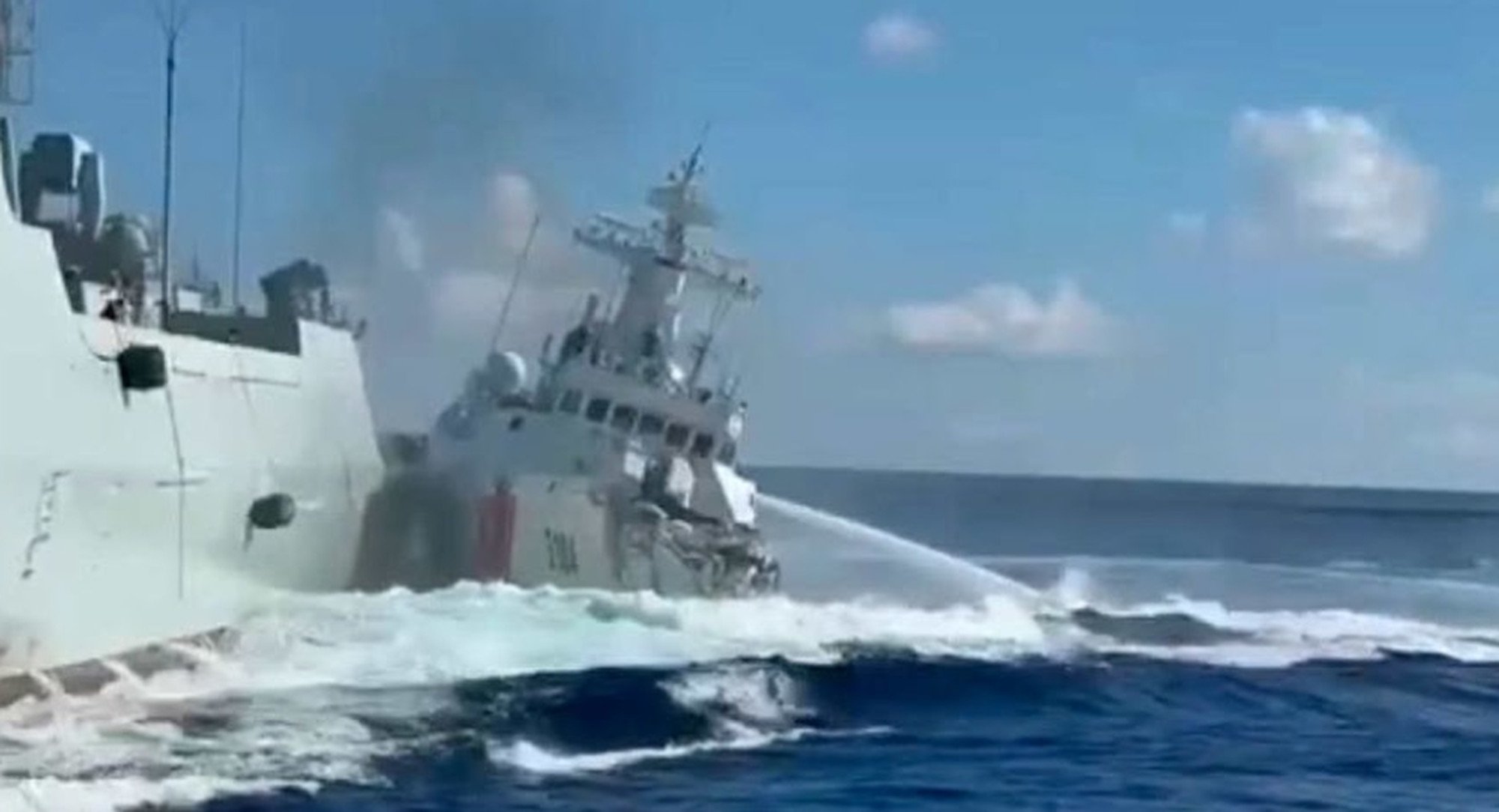
On Monday, Manila claimed that a China Coast Guard vessel sustained severe damage to its bow after colliding with a larger People’s Liberation Army (PLA) Navy ship the Guilin, a Type 052D guided-missile destroyer, while chasing a Philippine coastguard ship.
The incident occurred in contested waters near Scarborough Shoal, known as Bajo de Masinloc in the Philippines or Huangyan Island in China.
China has yet to confirm the collision. Gan Yu, the coastguard spokesman, only mentioned a move to expel the Philippine vessel on Monday, saying China had taken “necessary” measures – including tracking, monitoring, intercepting and blocking – and describing its actions as “professional, standardised, legitimate and legal”.
He said the coastguard would continue its law enforcement activities to “safeguard national territorial sovereignty and maritime rights and interests”.
Chester Cabalza, founder and president of International Development and Security Cooperation, a Manila-based think tank, said China was likely to push for a greater maritime presence in the region to project power.
“China will try to redeem its image at sea to show they have grit in the world, and that it still possesses the largest naval armada and coastguard fleet,” he said.
He added that the South China Sea would be a setting for “security anxieties” as China’s navy and coastguard were expected to “coalesce to correct” their navigational “error and failure” in the waterway.
That view was echoed by Collin Koh, a senior fellow at the Institute of Defence and Strategic Studies at S. Rajaratnam School of International Studies in Singapore, who said the region needed to prepare for increased tension.
“Beijing will not roll back; in fact, [it] may strengthen its posture in the area. Because when a collision like that happens, then you suddenly see yourself rolling back, what signal are you sending to your rivals in the South China Sea,” he said.
“So I [don’t] think Beijing wants to send that signal…potentially, it means more tensions in the area”.
Koh predicted that China might expand its voyages to nearly all the contested areas it deems crucial, including Second Thomas Shoal and Sabina Shoal , as a show of strength to Manila after the collision.
Scarborough Shoal is claimed by both countries but is controlled by Beijing. It is among the most hotly contested maritime features in the South China Sea and has been the subject of an increasing number of clashes between Chinese and Philippine coastguard vessels.
The triangular-shaped feature, consisting of a handful of rocks and reefs, falls within the Philippines’ 200-nautical-mile (370km) exclusive economic zone, while China has claimed it as part of the Zhongsha Islands, taking de facto control in 2012.
Tensions over the shoal and other contested features in the South China Sea have become more frequent. From 2021 to August 2024, at least seven collision incidents involving Chinese coastguards and either the Philippine coastguards or supply vessels have been documented.
After Monday’s incident, Philippine President Ferdinand Marcos Jnr said he would “never instruct any of our vessels to back out”.
“We will continue to be present. We will continue to defend our territory. We will continue to exercise our sovereign rights. And, despite any opposition from anyone, we will continue to do that as we have done in the past three years,” he said.
However, according to Koh, even though Manila was actively portraying the collision as a success for the Philippines, it would not look to make any further assertive moves to anger Beijing.
Since May, Manila has been engaged in the Kadiwa initiative to encourage fishing near Scarborough Shoal, and provides necessary supplies, such as fuel.
“For capacity reasons and mostly political reasons, the Philippines will be hamstrung in pushing any further. Assuming that the Philippines managed to muster enough coastguard and naval forces, I don’t think Manila will do anything more than … supporting fishery operations in the area,” Koh said.
Often referred to as “China’s second navy”, the Chinese coastguard is a quasi-military force that has been rapidly expanded in the past decade to become the primary enforcer of what Beijing sees as its marine rights in disputed areas.
Its navy – typically operating larger ships – focuses on security surveillance and is rarely engaged in directly handling marine disputes to avoid escalation.
Ding Duo, an associate research fellow at the National Institute for South China Sea Studies, said the reported collision exposed “a lack of coordination” between the navy and the coastguard and was likely to prompt more drills between them.
“[Therefore], the coordination and cooperation between the navy and coastguard vessels will be strengthened in the foreseeable future. They will improve and enhance on-site dispatching and other aspects,” Ding said.
Ding said that as the Philippines continued its operation in the disputed waters, stand-offs – or even confrontation – between the Philippines and China would continue, despite the accident.
“China will try to avoid collisions, whether it is with Chinese ships or Philippine ships. However, this will not give the Philippines much opportunity to take advantage of the situation. China will pay any price to defend its territorial sovereignty.” – SOUTH CHINA MORNING POST











Leave a Reply