

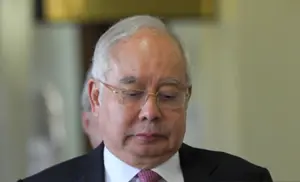
Najib’s house arrest bid: Royal exercise of clemency bound by Constitutional limits, says judge
KUALA LUMPUR: The exercise of clemency by the Yang di-Pertuan Agong is not absolute as it has to be carried out in accordance with Constitutional limits, says the High Court.
Justice Alice Loke, in her decision on Monday (Dec 22), said the Yang di-Pertuan Agong is a constitutional monarch and exercises powers and functions in accordance with the provisions of the Federal Constitution.
“The exercise of the prerogative power of mercy is no exception. It must be exercised within the legal framework providing safeguards and limits in the Constitution,” she said in her 41-page written judgment.
ALSO READ: Najib’s house arrest bid rejected
On Monday, Justice Loke dismissed former prime minister Datuk Seri Najib Razak’s judicial review in his bid to serve the remainder of his prison sentence under house arrest.
While the existence of an addendum order to that effect was undisputed, the court made a finding that the order became invalid as it was issued outside of the constitutional framework.
Justice Loke, who said she was fortified in her views by the Federal Court’s previous decisions, said the apex court ruled that the powers of clemency were subject to procedural limits in Article 42 when exercising powers of pardon.
“It has to be carried out in accordance with the constitutional limits prescribed by Article 42 of the Constitution, particularly through the framework of advice and procedure embedded therein.
“Pursuant to Article 42(4)(b), the Yang di-Pertuan Agong is required to act on the considered advice of the Pardons Board for the Federal Territories.
ALSO READ: Najib to appeal dismissal of house arrest bid
“His function in the clemency process is therefore inextricably tied to the deliberations and recommendations made by the board established for that purpose.
“The Pardons Board for the Federal Territory of Kuala Lumpur is constituted under Article 42(5) of the Federal Constitution, and comprises the learned Attorney General, the Prime Minister, and three other members appointed by the Yang di-Pertuan Agong.
“Article 42(8) further mandates that any meeting of the Pardons Board must be held in the presence of the Yang di-Pertuan Agong, who shall preside over its proceedings.
“This requirement is both procedural and constitutional in nature,” Justice Loke said.
Najib is currently serving a sentence imposed by the High Court that found him guilty of abuse of power, criminal breach of trust and money laundering in relation to RM42mil siphoned from SRC International Sdn Bhd, a former 1MDB subsidiary.
In the high-profile case, Najib exhausted his appeals as he failed to overturn his conviction and sentence.
On Feb 2 last year, the Pardons Board announced in a statement that it had reduced Najib’s initial 12-year jail sentence and RM210mil fine to six years and a RM50mil fine.
ALSO READ: Anwar calls for respect, patience after Najib’s house arrest bid denied
According to the statement, Najib will be released on Aug 23, 2028.
“However, if the fine is not paid, a year will be added to the jail term, and the release date will then be on Aug 23, 2029,” it said.
Two months later, on April 1, 2024, Najib filed an application for leave for judicial review, claiming that there was a royal addendum order that would have allowed him to serve his prison time under house arrest.
He named the Home Minister, the Commissioner General of Prisons, the Attorney General, the Federal Territories Pardons Board, the Minister at the Prime Minister’s Department (Law and Institutional Reform), the director-general of Legal Affairs at the Prime Minister’s Department, and the government as the first until the seventh respondents respectively.
In the notice of application, Najib sought a mandamus order that all of the respondents or one of them answer and verify the existence of the addendum order dated Jan 29, 2024.
Najib sought a mandamus order where, if the addendum order exists, all or one of the respondents must execute the royal order and immediately move him from the Kajang Prison to his residence in Kuala Lumpur, where he would serve his remaining sentence under house arrest.
His lawyer Tan Sri Muhammad Shafee Abdullah informed the court that Najib would be appealing the High Court’s dismissal.









Leave a Reply